TO FIND THE BOBOLINK
By: Juan Manuel Zara
Published on April 1st, 2025
Comments: 5
Communication #2, visits #1746A tour through the hot wetlands of Santa Fe province, in the middle of summer, searching for a migratory bird that arrives in Argentina from North America.
Birdwatchers sometimes do things that seem inexplicable to those who are not birdwatchers. For example, going to the north of Santa Fe province in early March, when the temperature in the shade still does not drop below 35°C, just to see one little bird. Everything is humidity, everything feels unpleasant and sticky, and everything is seen through a wavering layer of heat; and yet, a bird can make us return home, recounting that experience as something fantastic.
I particularly love that landscape. It reminds me of the novels of Juan José Saer. In the lowlands of the Paraná coasts of Santa Fe, wetlands, islands, and rice fields thrive. And this makes it the favorite spot for the migration of the Bobolink.
Every year, hundreds and thousands of birds arrive in Argentina in migrations that can span the entire continent. Among them —those coming from North America escaping the winter— are the Bobolinks (Dolichonyx oryzivorus). During the months of our summer, they visit floodplains in the country, and perhaps one of the best times to search for them is the last weeks of February and the first weeks of March.

Not only because the heat is less intense than in December or January, but because this little bird makes long stops in the middle of its journey and does not reach Argentina until mid-spring, unlike other migrants. Records of this species become more frequent starting in January. But there is also another advantage to searching for it during this time: the males, preparing for the return, already sport their distinctive breeding plumage, as I could confirm with my own eyes.
In March 2024, with two friends, we went for a weekend to the Santa Fe town of San Javier to meet these Bobolinks. We followed a precise spot, not far from the village, where the species is reported year after year — it appears in eBird as “Bañado Arundinicola,” perhaps because the White-headed Marsh-tyrant (Arundinicola leucocephala) was once seen there. The surroundings of the area are perhaps the closest place to Buenos Aires where the Bobolink is regularly seen.
The landscape is abundant with floodable lands and lagoons formed along the sides of the roads. Not to mention the shores of the Paraná river (the best river in the world). Therefore, species related to water are not lacking, such as Snail Kites (Rostrhamus sociabilis), Striated Herons (Butorides striata), Kingfishers (of all three sizes; Megaceryle torquata, Chloroceryle americana, and Chloroceryle amazona), or the Black-backed Water-tyrant (Fluvicola albiventer), the queen of wetlands.

And thank goodness all those creatures showed up, because the Bobolinks made us wait.
On the first day, the heat made us somewhat lethargic. Moreover, on the way there, we indulged ourselves by stopping along the road at every little waterhole we found. These spots, small oases among crops and grazing areas, are teeming with biodiversity. We got to see a family of at least ten Red-crested Cardinals (Paroaria coronata), most of them juveniles, still with their orange crest. We also saw two or three individuals of the Black-backed Water-yrant, a tyrant flycatcher associated with rivers, similar to the White-headed Marsh-tyrant and roughly the same size. It takes advantage of bodies of water to feed on insects. It usually moves between tree branches and shrubs that fall near the water. It peeks out, hides, and then reappears further down to "catch little bugs."
I was able to see it hunt in two other ways. One of the strategies is “fishing like a Kingfisher.” This means flying low over the water to catch prey. When it does this, it’s very easy to spot because, with its combination of black and white, it’s not a bird that passes unnoticed. The other method I saw them using to feed is similar to the technique of the Ground-tyrants (Muscisaxicola sp.) or the Cattle Tyrant (Machetornis rixosa) — two other tyrant flycatchers. They perch on floating plants, such as Water Lettuce or Hydrocotile sp., and forage as if they were on the ground.
For the second day, we started late, as it had rained all morning. We didn’t want to risk muddy roads and preferred to explore the surroundings of San Javier, looking for an accessible place to watch birds in general. We took advantage of the opportunity and started our search along the shores of the Paraná. Of course, there weren’t going to be any Bobolinks there, but we delighted in watching a large family of Amazon Kingfishers (Chloroceryle amazona).
There were approximately five individuals. All of them walking together. It seemed like a lot for an animal that, in any case, is usually seen in pairs. Earlier, we had seen a Ringed Kingfisher (Megaceryle torquata) fly over us. That one just kept going. The Amazon Kingfishers were just hanging around in an area at the end of a trail, where the river widened and met another arm, forming a kind of lagoon.
Among all the individuals, most had the plumage typical of females. Females and males are distinguished because the males have an orange collar, while the females have an incomplete green collar. However, it's very possible that they weren’t necessarily females, but juveniles of either sex. At least one was begging for food from an adult male. The presumed father left it with a fish that was as long as its beak and flew away.
It's incredible how versatile these creatures are when it comes to hunting. We recorded at least three different methods. Only the adult male was hawking over the water. The females and juveniles alternated between fishing from a perch and making low passes over the water. In the first case, they had less success than in the second. When they finally caught a fish, if it fought back, they slammed it against the branches.
Now then: although I never get bored of all these creatures or the wetlands, we hadn’t traveled over 600 km just for them.
It was only on the third day — our last opportunity — that we were able to see the Bobolinks.
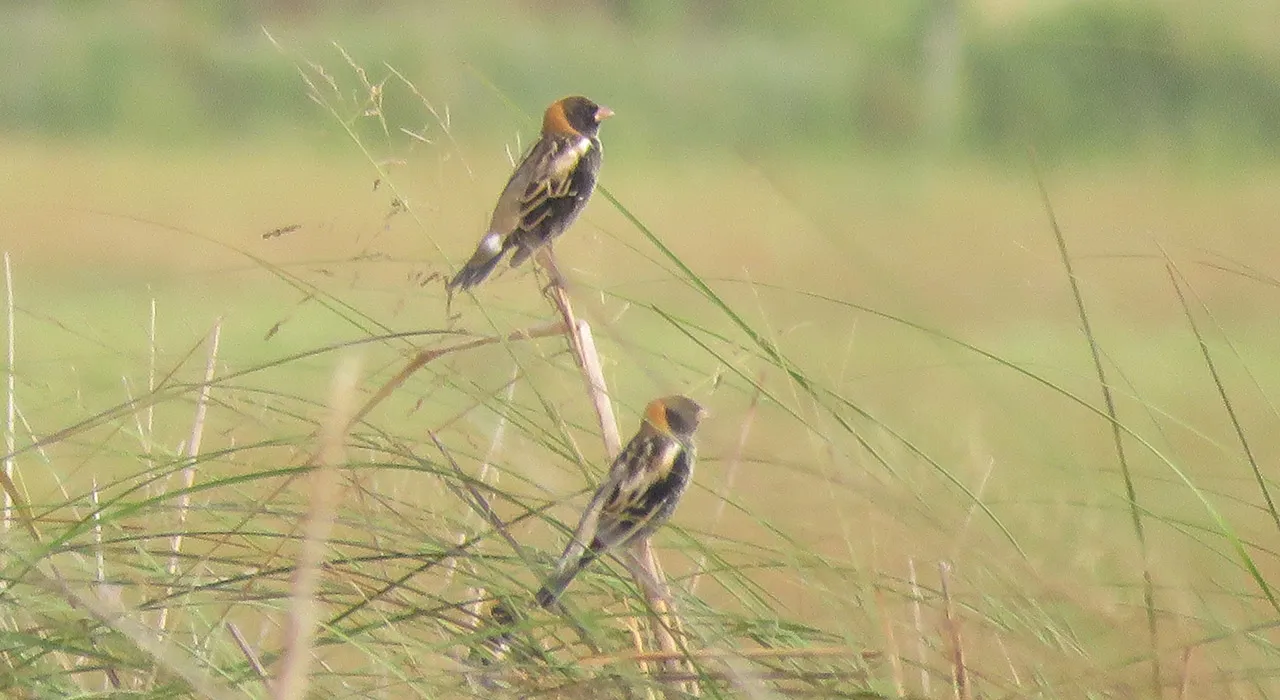
First, we saw just one, isolated. A male already in its breeding plumage. It was perched on a wire next to a White-browed Meadowlark (Leistes supersiliaris). It sang for a while and then flew into a reedbed. That’s when we saw there were about thirty of them! Later, we found other separate groups in different patches of tall grass, where there were many more — up to almost 100 individuals.

Although they usually inhabit rice fields, we saw them in an uncultivated area. The previous two days, we searched in cultivated fields and had no luck. They were using grass from the genus Coleataenia, or Redtop-Panicgrass. As far as I understand, it is a typical grass of the wetlands in the Paraná floodplains. The Bobolinks did not feed on the seeds but used this plant only as a perch and shelter. Instead, they preferred to feed on the ground.
They are noticeably different from the Congo Chestnut-capped Blackbird (Chrysomus ruficapillus) — there would be about a thousand of those in the same area — and it’s impossible to confuse them. Although the males may already appear somewhat dark by this time, their white patches are evident in flight. They even had a colored nape, a sign that they were ready to return north. Additionally, they are much smaller than the others. The females, on the other hand, are bright yellow.

Otherwise, their behavior is typical of blackbirds, though they move particularly low. They almost never rise above the grass line, unless they need to move far, and they don’t expose themselves much. They search for food on the ground while a group stays above, singing and keeping watch. Those on the ground are practically invisible, except for small jumps they make to move.
Then, they fly up, perch, shake their tails to balance, and preen themselves. Suddenly, dozens of them may take flight from the ground and disappear into the reedbed. The Chestnut-capped Blackbirds, on the other hand, when resting, do so all exposed on top of grasses and reeds.
The Bobolinks also have a less frantic movement than the others. When they need to take off, to move from one clump of grass to another, they scatter a bit but don’t fly in circles. They rarely go very high. They immediately descend, and the cloud of Bobolinks disappears into a new reedbed.
They also don’t make much of a fuss in the face of threats. When there is danger, those foraging on the ground make a leap and seek shelter with the rest of the group. At least, that’s what they did when a Southern Caracara (Caracara plancus) flew directly above them. In the air, the white shoulders of the males could be confused with the yellow shoulders of the Yellow-winged Blackbird (Agelasticus thilius), but it should be noted that the Bobolinks also have a white undertail.
At one point, the Chestnut-capped Blackbirds had scattered far from where we were, and we could hear the racket that gives these migratory birds their name. Although they are not particularly "chatterboxes" compared to the Chestnut-capped Blackbirds, who sing louder. The song of these birds is higher-pitched, sustained, and modest. It’s true that they never seem to stop calling. But their song has no particular feature.
The recessive plumage, identical between males and females, is simpler, and seen from a distance, it can be confused with seed-eating birds. Grassland Yellow-finches, Saffron Finches, Rufous-collared Sparrows chicks, or even House Sparrows — although there shouldn’t be many in the area — could be disorienting. The Bobolinks have pink beaks and legs, some streaks on their chest, a gray back, and a yellow eyebrow that contrasts with their dark forehead.
To find them, there are two roads around the "Bañados Arundinicola" that depart from Provincial Route 1: one further north that crosses rice fields and one further south — crossing a gate that might be locked — going through grazing areas. Another reliable option listed on eBird as "Bañados de Ruta 73". In general, from that point northward, the entire western coast of the Paraná River has records of the Bobolink.
As we were leaving, satisfied with our expedition, another animal appeared to bid us farewell, reminding us that not everything is birds. On the side of the road, we came across a huge Hydrodynastes gigas. Its name means "greatest of the water mistresses" and its attitude makes it deserving of the title. We were able to verify something we had heard: it is an aggressive snake that has no problem putting up a fight. In this case, it confronted nothing less than the car! It raised its head and compressed its body to appear larger. When it realized we weren’t a threat, it slithered between the plants and returned to the water.

Returning to the Bobolinks, I recommend taking advantage of the last weeks of February or the first weeks of March to go search for them. Seeing them and having their flocks flying overhead is a spectacle. Although globally listed as a "Least Concern" (and threatened nationally), it remains a creature at risk due to pesticide use, habitat loss, and hunting. Moreover, like all birds that travel across the continent annually, it is a kind of natural wonder.
You can find more chronicles by the author at: https://avesengeneral.substack.com/
Share this communication:
Muy linda crónica Juan. Sin dudas un bichazo
Espectacular forma de plasmar la experiencia!!! fui hace muchos años y me dieron ganas de volver!!!
Muy linda nota que te hace imaginar todo lo que vivenciaste!! Hace tiempo que decimos con Jorge de ir a buscarlos, es una especie que yo todavía no conozco... El año que viene será!
Hermoso relato..muchas gracias por compartir tu experiencia...
¡Bellísimo y experto relato!
For more communications, go to Communications.